All about honey, what Winnie The Pooh didn’t teach me. Well, first, what did Winnie The Pooh teach me? That if bees were bears, they would build their homes on the ground so there wouldn’t be so many stairs to clime to get to the honey. Makes sense to me!
- Natural Honey
- So what does “natural honey” really mean when you see it on a bottle?
- Pollen and Beebread In the Honey
- Heated Honey
- What about baking with honey? Won’t it get too hot?
- Crystalized Honey – Is It Bad? What To Do!
- Enzymes in Honey
- Using Honey For Medicine
- What is Propolis – What Is It Used For?
- Beeswax
- Types of Honey
- Honey Importation and Adulteration
- Qualities of Good Honey
Natural Honey
Honey is a natural product of honey bees. There are several different types of honey bees, most people think of the kind that beekeepers have, officially known as the Apis mellifera. Bees make thousands of trips to collect nectar and pollens from flowers, and to collect resins from plants and water from puddles, ponds, rivers, dog bowls, swimming pools, and other sources of water.
The resins get chewed and mixed with wax to make propolis, a thick sticky substance when warm, turning hard when it cools. Often this propolis is aromatic and has a pleasant smell to most people. Bees use the propolis to seal the insides of their hive, plug holes, and as a glue when they think they need it.
The nectar gets mixed with enzymes from the bees, and is used as food for the bees. A healthy colony will gather and store the excess in honeycomb, dry it, and, when it gets to about 18 to 20 percent water, will seal that comb with a thin layer of wax. Honey naturally has an acidic pH about the same as vinegar.
The pollen is a source of protein, vitamins, and minerals the honey bees make into what we call beebread. Beebread is made by the honey bees by mixing it with enzymes from the bees, then put into a honeycomb cell to ferment, much the same process as cabbage is fermented into sauerkraut (but, of course, doesn’t taste anything like kraut). Then it is sealed with a layer of honey.
Read on for more information about honey, bees, propolis, and beeswax.
So what does “natural honey” really mean when you see it on a bottle?
Well, that is where things get a bit tricky. In my case, my honey is the product of the bees, strained to take out any larger bits of wax and propolis, etc., without further processing. And a few beekeepers, often small local beeks (short for beekeepers), will do the same.
But some producers take that same honey and filter it to remove the naturally occurring pollens. Many of them go a step further, heating the honey to melt any microscopic sugar crystals that may have naturally formed in the honey. The reason for doing so is to remove any microscopic solids. These solids are what allows the honey to crystalize. This changes the honey.
To my knowledge, as of the time of this writing, there are no regulations regarding the use of the word “natural” on a label. In the USA, there are no regulations for honey, other than it cannot be adulterated and has to list all the ingredients in the package, along with any recognized allergens like nuts or dairy, etc. In the EU, there ARE purity regulations that must be met. You can google those if you need to.
Pollen and Beebread In the Honey
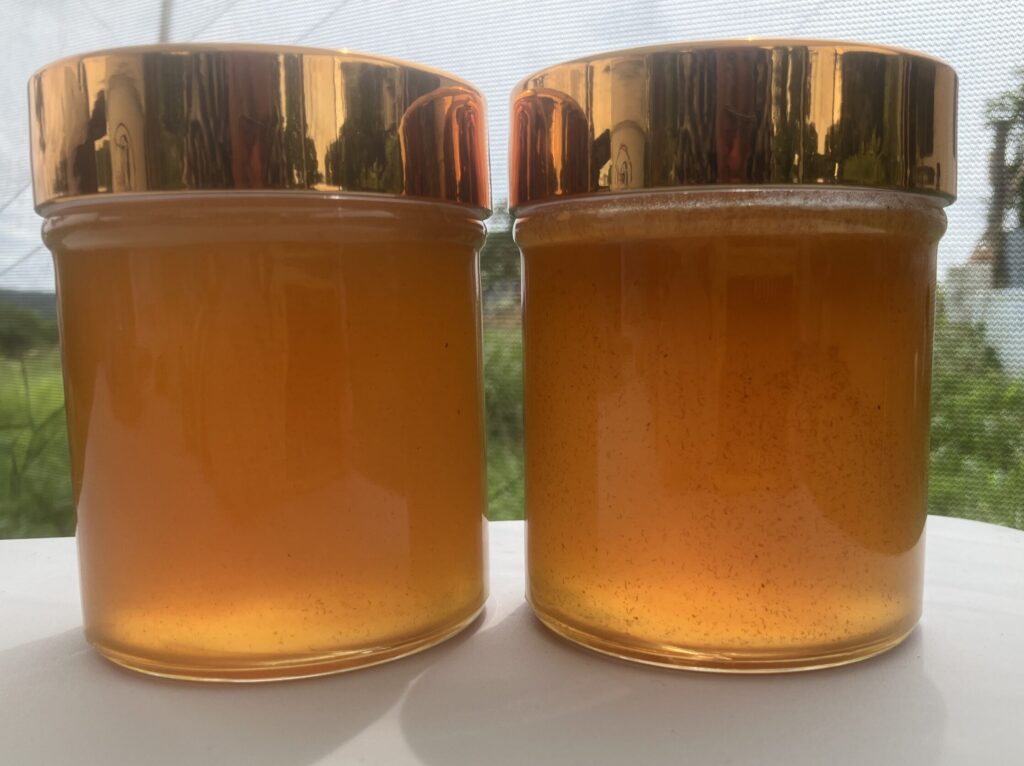
The naturally occurring pollens in the honey provide us with healthy micronutrients. They also add to the flavor profile of the honey. That is why honey harvested in the spring tastes different than honey harvested in the fall – the nectar and pollens come from different plants that bloom at different times. So, removing the pollens not only changes the flavors, but also changes the nutrient profile.
Since pollens come from differing flower sources, they can have many colors. Whites, greys, yellows, browns, greens, reds, and so on. These pollens are super important for rearing the young brood. So, in order to rear brood early in the spring, before flowers start to bloom, bees need to store this pollen. Bees ferment the pollen into beebread for long term storage. But, when fresh pollen is available, bees prefer to use that. This is why we can harvest beebread without hurting the colony.
In some parts of the world, consumers seek out beeks who harvest the beebread separately from the honey. This is a time consuming and laborious task, and prices for the beebread reflects that. A less expensive method is to obtain beebread honey from a beek. This is called beebread honey, and is made by pressing the honeycomb in a fruit press. This destroys the honeycomb, but beeks will also have beeswax as a product from this process. Since beebread honey is a very specialty product, it commands a premium price.
Heated Honey
In the summer, bees keep their hive temperature about the same as your body temperature. During the winter, depending on where the honey is stored, honey can cool down quite a bit. Seldom, if ever, would honey in the wild ever get above 100 degrees F, 37.8 degrees C.
Higher temperatures will change the honey and destroy it’s value. Temperatures above 104 degrees F, 40 degrees C, will destroy the natural enzymes in the honey, reducing it’s natural antibacterial properties. And, temperatures above 140 degrees F, 60 degrees C, will destroy the vitamins in the honey.
In Europe, honey purity laws prevent the high temperature treatment of honey. In the USA, there are no regulations for such. So, why heat the honey to these high temperatures? It will melt the microscopic sugar crystals natural in honey. This prevents the honey from crystalizing for an extended time. Here in the USA, consumers, unless they know better, will not purchase crystalized honey, thinking there is something wrong with it.
What about baking with honey? Won’t it get too hot?
Cooking with honey imparts a special taste to foods that you can’t duplicate with other sugars. Yes, it does destroy the enzymes and antibacterial properties. But cooking does not produce any toxic or unwanted substances. So, go ahead, use honey in your cooking. After all, the taste is what makes it great!
Crystalized Honey – Is It Bad? What To Do!
Natural untreated, unfiltered honey will crystalize. In fact, some producers will create crystalized honey in a controlled manner. This is how “honey butter” is made. This is normal, and shows the knowledgeable consumer that this honey is of high quality. But, how can you use crystalized honey?
Well, that is simple. If you warm honey to around 100 degrees F, 37.8 degrees C, the crystals will melt. You end up with natural honey in it’s original form, with all the antibiotic and enzymatic properties intact. Just place the honey in water that is warm, but not hot to the touch. Keep that warm temperature until the crystals have melted away. Over time, the honey will recrystalize, and you may have to repeat this process. This is easier to do with smaller batches of honey. So if you buy your honey in larger quantities and are going to store it for longer times, it may be a good plan to separate it into smaller jars.
Enzymes in Honey
Bees mix enzymes into the honey naturally. These are the same enzymes your body produces to use sugars for energy. They include invertase and glucose oxidase. So why, if your body produces these enzymes already, would you want them in your honey? Well, they are part of what gives honey it’s natural antibacterial property.
Invertase is a compound that breaks apart sugar (chemically combined glucose and fructose molecules) into their separate components. When separated, these are called “invert sugars”. Glucose is the sugar that your body can use to make energy. Fructose, on the other hand, has to be processed by your liver into something else before your body can use it.
Glucose Oxidase in another compound that works on the glucose molecule. It breaks it down into gluconic acid and hydrogen peroxide. This is what gives honey it’s antibacterial properties, and helps preserve the honey. It is also used in food production to prevent browning and as a dough conditioner.
Using Honey For Medicine
IMPORTANT: I am not a medical provider, and this is not intended to be medical advice! It is a history of the medical uses of honey. Seek professional medical care when appropriate!
Honey’s antibacterial properties have been known for a long, long time. It has been used to prevent infections in minor cuts and abrasions before we had antibiotic ointment. Although antibiotic ointment will fight more types of infection, in it’s natural unheated form, honey can still help until you can obtain the ointment.
In the past, honey was also given to people with sore throats. For this to work, you have to swallow the honey, but not eat or drink anything while the honey coats the throat and does it’s magic.
Note that the honey cannot be heated, as many store bought honeys are. For this destroys the antibiotic properties.
One other great thing, honey will prevent bandages from sticking to a wound. I have tried it, and yes, it really does.
What is Propolis – What Is It Used For?
Trees, when injured, often will leak sap from that injury. This is similar to you bleeding when you get a cut. It helps flush out infection and debris. Later, you get a scab, a covering that seals the wound. In the case of a tree, they produce a resinous substance. This thick sticky substance has antimicrobial properties, depending on the tree species. (Sometimes insects trying to get inside the trees outer bark will land on this and become trapped. Over eons of time, this resin can become what we know as amber).
Typically, more in the fall, honeybees will gather this resin from various trees (and other plant sources). Each type of plant produces a different type of resin. Bees bring this resin back to the hive and use it for it’s properties. Bees will mix this resin with beeswax, which makes it into propolis. Propolis is a sticky paste. Depending on the bees needs, it can harden or be maintained as a paste.
First, it is a sealant. It can be used to seal cracks and openings in a beehive or in a hollow tree. It also is used to seal the inside of the cavity which helps with moisture levels in the hive. Most of the time, this propolis will harden to a smooth, tough, substance.
Second, it is a glue. On occasion, bees will glue things together in their hive. What and why is so variable that I cannot give any specific examples here, but they do it.
Third, it is an antimicrobial. The antimicrobial action of propolis has been demonstrated in studies. The specific actions vary depending on the source of the resin.
Fourth, it is sometimes used as a tomb. Bees will clean their hive of the dead, whether it be bees or other animals. But, for example, when a mouse gets into a colony and dies, it is too big for the bees to carry it out of the hive. When this happens, they will entomb the animal in propolis. This prevents the decay from infecting the colony.
We humans also have used propolis. It usually has a pleasant earthy, sometimes spicy, woody smell. Warmed propolis has been used for this purpose. Propolis has also been used in the past as an ingredient in ointments and wound plasters. It has strong antimicrobial properties, and according to PubMed, reduces scarring, accelerates healing time, and promotes tissue repair. It can also be used as an ingredient in DIY rainproofing of material. At one time, and still in some parts of the world, it is chewed for dental hygiene.
Beeswax
Beeswax is a unique compound that has never been duplicated by humans. It is excreted from wax glands located on the abdomen of honeybees. When fresh, it is quite soft and white as freshly fallen snow. Over time, as the bees work the wax, it will take on a yellow color. This yellow wax is stronger and not as delicate as the fresh white wax.
Bees, of course, use this wax to make honeycomb. Often, to strengthen the wax, it is mixed with small amounts of other substances, like propolis, to make it tougher. This wax also has a unique smell that is most pleasant. As the aromatics leave the wax, or bees work the wax, or, depending on what the wax is used for (brood rearing, honey storage, beebread, etc.) it becomes tougher, until, in some cases, it feels like paper.
Beeswax can be melted and used with liquid oils to make ointments and creams. It is an ingredient, sometimes along with propolis, to make a flexible DIY waterproofing coating. It is oft times used as a lubricant for wood screws by woodworkers. It is used as an industrial lubricant in some situations. And, is used in some chemical compositions for it’s properties.
During WWII, while sugar was rationed in the USA, and especially in England, honey was not. The reason being, the war departments needed the beeswax for munitions production. Honey was the byproduct of the war effort, so went unregulated, thus used as a sugar substitute.
The purest and best wax for candle making is pure beeswax. The Catholic Churches often had beehives for the wax they wanted for candles. On the plus side, the smell of the burning beeswax is the bestest candle smell there is. It is the original smell good candle. Many people feel a calm effect from it’s odor.
There are far more uses for beeswax. It is used in the cosmetic industry, lip balms are made from it, it is used in ointments and creams for skin care, and so on. The uses are far to numerous for me to mention but a small part.
Oh, and by the way, beeswax from treatment free, antibiotic free, chemical free colonies is non-toxic. So, some have chewed it as a gum. Should you ever swallow some, it will not harm you. So feel free to look for that treatment free, antibiotic free honeycomb honey.
Types of Honey
One more thing that Pooh Bear didn’t get into. There are as many types of honey as one can imagine. We, here in the USA, have usually heard of “pure clover honey” and “wildflower honey”, and, sometimes, even “buckwheat honey”.
Honey is often described by the floral source, when known. These are often related to a region. For example, Manuka Honey is sourced from New Zealand, where the Manuka tree grows. Several decades ago, in New York, the buckwheat fields were so vast that buckwheat honey was produced. Today, rapeseed (Canola) honey is sold in volumes.
In theory, here in the USA, where there are minimal regulations on honey, if a single floral source can be identified, and all the honey put into storage by the bees is done during that nectar flow, it can be labeled as (floral source) honey, such as Almond Honey. Proving the floral source, scientifically, can be time consuming and expensive, and without the regulations in place, most people simply accept the honey producers word.
Honey can also be described by it’s properties and/or flavors added. Creamed honey (Spun honey, etc.) is honey that has been crystalized in a fine textured crystallization process. This gives it a creamy buttery spreadable consistency. Heating it, though, returns it to liquid form. So using it for baking makes for a more expensive option. Some producers also put flavorings in their honey. Here in the USA, this does have more regulation. Ingredients must be listed on the label, and the addition of ingredients makes it a manufactured item, requiring an inspected kitchen. Creative flavors abound, such as cinnamon honey, jalapeno honey, cherry honey, peach honey etc. (Not to be confused with peach butter sometimes labeled as “peach honey” in certain old recipes).
Honey Importation and Adulteration
The USA is a honey importer. Both imported and domestic honeys can be pure and natural, can be filtered and/or heated, can be accurately labeled, and so on. In the USA, contaminated and adulterated honeys are sometimes found in our grocer supplies.
In the case of filtered and heated honey, it is nearly impossible to determine if honey is 100% pure honey, or if it is corn syrup. Both have similar sugar properties, and without the pollen, and the microcrystals, both will remain liquid on the shelf for very long times. Since consumers in the USA think that crystalized and cloudy honey is somehow inferior, those golden liquid honey jars are what sells. And, there have been known instances over the years of honey that has had corn syrup added without stating so on the ingredient label. So how can one tell?
Pollen, as the EU knows, is the first way of tracing honey’s origin. Each botanical source has a different pollen, which looks different and has different colors. But, when pollen is present, it does two things that consumers in the USA don’t understand. First, it clouds the “pure” look of the honey, sometimes even having flecks of pollens to the naked eye. Second, pollen can be the catalyst for crystal formation, which is seen as inferior to the untrained USA consumer.
Commercial honey producers in the USA often have what we call “migratory” bees. The beehives are moved from one part of the nation, sometimes thousands of miles, to pollinate almond orchards in California, apple trees in Washington, melons in the north, etc. When each of these pollinations are complete, before the bees are moved again, honey is harvested. This honey goes to processing, where it is made clear and crystal free. Since the pollination is the money maker for the commercial beek, the honey is sold cheaply all the way to the retail shelf. Even then, corn syrup can be cheaper than processing the honey, and some unscrupulous processors have added corn syrup to increase their profits.
The best way for someone in the USA to be sure to get pure premium honey is to locate a local beekeeper that does not indulge in migratory beekeeping, and purchase their honey from them. This means they are paying a premium for the honey. Organic shops often have suppliers that are known to them to be non-migratory, and also sell pure premium honey from these smaller apiaries. A little knowledge and a few questions can go a long way in obtaining unadulterated and pure honey.
Qualities of Good Honey
Good honey has several qualities that can help indicate that it is true honey. You may or may not want to invest the time and (small amount of) money to check. Some simple observations, and if you can find a specialty shop, a few questions may be all you need.
Both honey and corn syrup have similar pH values. Honey can range between 3.2 and 6.1, depending on the floral source of nectar. It usually runs around 3.8 or 4.0. Corn syrup is manufactured to have a pH of between 3.5 and 5.5. So, only if the honey pH falls inside the natural range, but outside of the corn syrup range can it indicate that the honey is actually honey and not corn syrup.
Moisture content can be a bit better for identifying honey. A good honey will range between 14 and 20 percent water. This can be measured easiest with a Brix meter. The Brix will be the opposite percent since it is measuring the non-water portion of the liquid. A Brix, then, of 80-86 is the normal range for honey. Corn syrup, on the other hand, is manufactured with a moisture content of 22.8 to 24 percent, or 86.0 to 87.2 Brix. Just slightly higher than honey.
The best way to check to see if there is honey (and this still has it’s limitations, especially when honey is mixed with corn syrup), is to use a microscope. Under a microscope, you can see the pollen, crystals, and other minor inclusions in unfiltered, unheated honey. Corn syrup, whether it is high fructose or not, is a manufactured sugar that does not have these inclusions.
If you simply don’t want to do that, the simplest ways are to shop from local beekeepers, at farmers markets, and in specialty shops and organic grocers. Ask questions about the honeys, and if you see some of the same brand honey that has a bit different shades of honey, or some (or all) bottles might be crystalized, and with a light shining through the honey, it has a slightly cloudy appearance, or if there is a surface skim (mostly microscopic particles of beeswax) on it, it is probably good honey.
Finally, honey harvested at different times of the year will have different shades of color, and will taste a bit different. This is because the nectar comes from different sources. It’s all good tasting though. So sit back and think a moment about Pooh Bear while you enjoy your pure, premium honey.
Mike